Shortening the operator learning curve on a new CNC controller
A new three-axis CNC machine sat idle after installation at the US-based machine shop. The operators were experienced, but they were still working through a 500-plus-page manual and rarely got to actual cutting.
The LAB412 team built an assistant and put it at the machine in 6 days. Operators get answers and prompts right when they need them, at the point of work. Two weeks after deployment, the machine was running at its desired production load.
Context
A manufacturing company had bought a new three-axis CNC machine running a Milltronics Series 9000 controller, to replace a simpler manual machine and speed up production.
The two operators were skilled but came from different backgrounds: one had run CNC on other controllers; the other had years on manual machines but had barely touched programmable CNC.
A few weeks after installation, the ramp-up was clearly too slow. The controller manual was complete but heavy. The operators kept reading and almost never got to actually running the machine. The new equipment sat unused, and production wasn't starting.
The company came to us with one problem: the new machine sits idle and the operators can't get started on it.
Approach
The constraints defined the solution: no time and no budget for a formal training course, production had to start now, and replacing the operators was off the table.
We didn't read this as "train the operators from scratch." They were experienced, and the documentation was already there. The problem was elsewhere: the knowledge lived in a 500-plus-page manual, while the question came up at the machine, in the moment of work. So the answer had to sit at the workstation itself.
We built an assistant that lives at the machine and answers operators' questions as they work — strictly from the controller's documentation, at the moment a specific decision has to be made.
Our work
It runs as an app on an Android tablet mounted beside the machine. The operator asks by text or voice and gets an answer from the controller's documentation: schematics, step-by-step instructions, and a pointer to the exact place in the manual.
We parsed the controller and machine documentation — hundreds of pages in all — kept its structure intact, and pulled it into a single knowledge base. The assistant builds answers only from that base and checks them against the source. If the manual doesn't have the answer, the system returns nothing — it doesn't fill the gap.
For equipment this matters more than completeness: a wrong prompt is worse than no prompt.
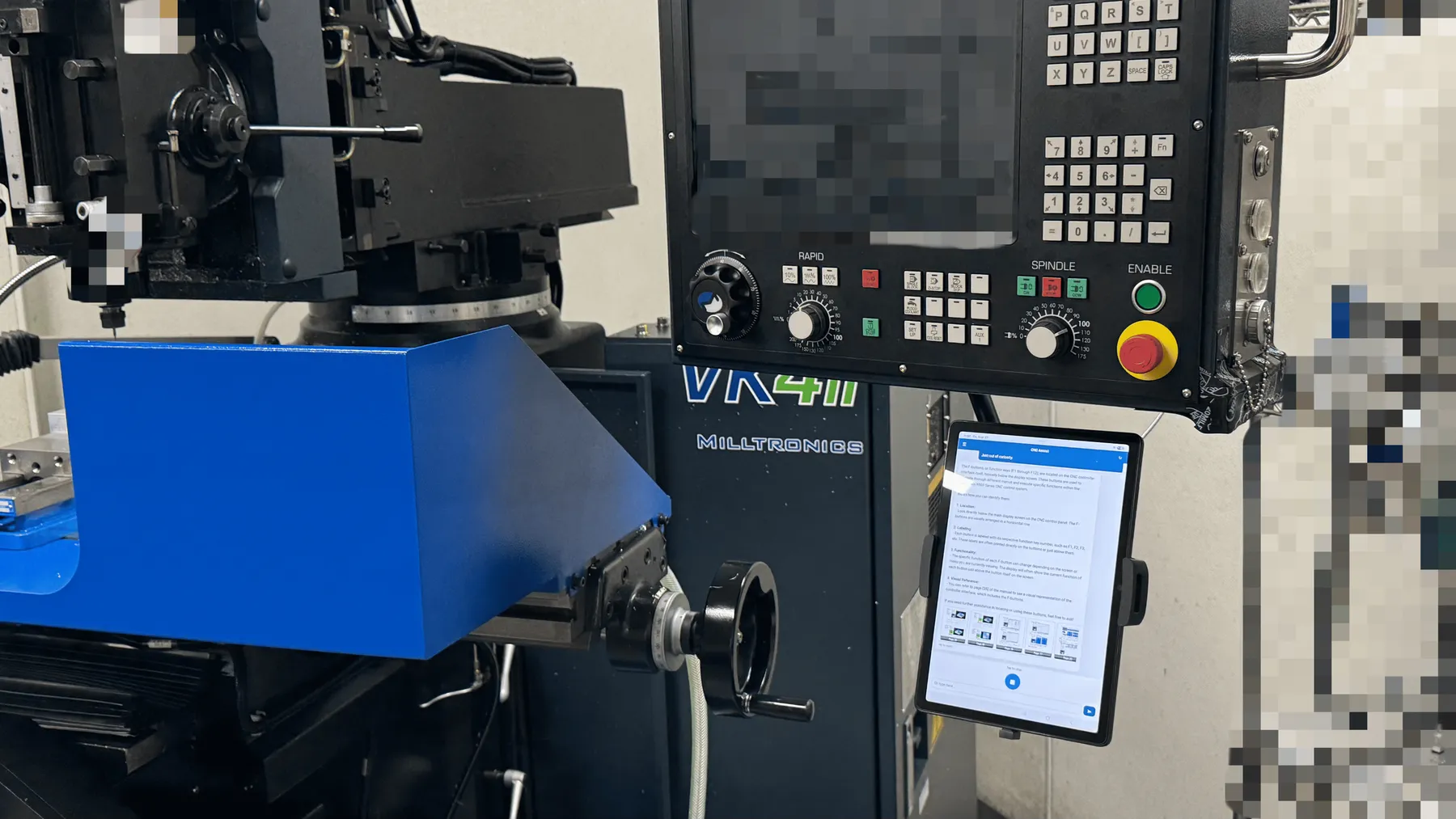
An operator can ask how to write a first program, what a given button does, which mode to pick, where an operation is documented, or what order to do things in. The question comes up in the middle of the work, and the answer leads straight to the next move — at the machine, not at a desk.
The assistant also adapts to each operator's background: the CNC-experienced operator gets shorter answers, framed in terms of modes, commands, and controller logic; the manual-machining operator needs some things framed differently: what used to be done by hand, what is now set by program, where it lives in the control interface, and what the sequence looks like. This shortens the path from question to action.
Idea to deployment took 6 days: in that time we gathered the operators' inputs, parsed the documentation set, built the knowledge base, set up the interface at the machine, and trained the operators.
The result
Before the system, the operators had spent weeks on the manual, and the reading never turned into real work. The machine was installed but wasn't doing the job it was bought for.
Once the system was in place at the machine, the operators were working on their own within a week. Within two weeks they were running the machine confidently and handling production work.
The tool keeps earning its place past onboarding. Employees reach for it to save time on new jobs and questions that come up.
In our experience, an experienced operator moving to unfamiliar controls can take up to two months. Here they reached a comparable level in a few weeks — from a harder starting point, since for one of them this was the first move from manual machining to programmable CNC.