Paperless job tracking for precision manufacturing
A precision metalworking company in California runs 41 machines and 60-plus workstations. Job status used to move from station to station on paper. The company already ran an E2 shop-management system, but the actual progress of operations — scrap, comments, current drawings — only got into it late, after someone re-entered it by hand, and the floor status wasn't visible in real time.
LAB412 built and integrated a digital operation-tracking system on top of the existing E2: operations are logged at the machine, the floor is visible to the production manager in real time, and prep for an ISO audit dropped from weeks to a few hours. Built and rolled out in about four months, the system has been running for more than four years.
Context
The shop runs a wide range of machines — wire and hole-popping EDMs, three-, four-, and five-axis machining centers, lathes and turn-mill machines, polishing and grinding, QA/QC stations, and more. Batches are small — tens to hundreds of pieces — but each part goes through dozens of operations, and most parts also need custom tooling made for them.
A traveler moved through the shop with the part, signed by hand at each operation, then re-entered into the digital system by a separate employee. That was a job in itself and a source of errors, and even then nobody ever got a full picture of the workload or the problems on the floor. The staff lived in E2 day to day.
Work progress, current load, and the status of any given order only showed up after a delay and a round of manual re-entry — there was no way to watch the shop in real time.
This isn't mass production with the same repeated operations. Batches are small, parts take different routes, and many orders need tooling of their own. The system had to handle not one standard sequence but the many different paths a part takes through the shop.
Approach
E2 remained the system of record — orders, materials, scheduling all sit in it, and replacing it would have been costly with no reason to. So LAB412 built a separate layer on top, with its own database and its own functions: orders and scheduling stay in the main system, while operation progress is captured at the machines.
The problem wasn't a missing ERP or MES; it was the gap between the plan in the system and the actual work on the floor. That gap was the only thing the new layer had to close.
Our work
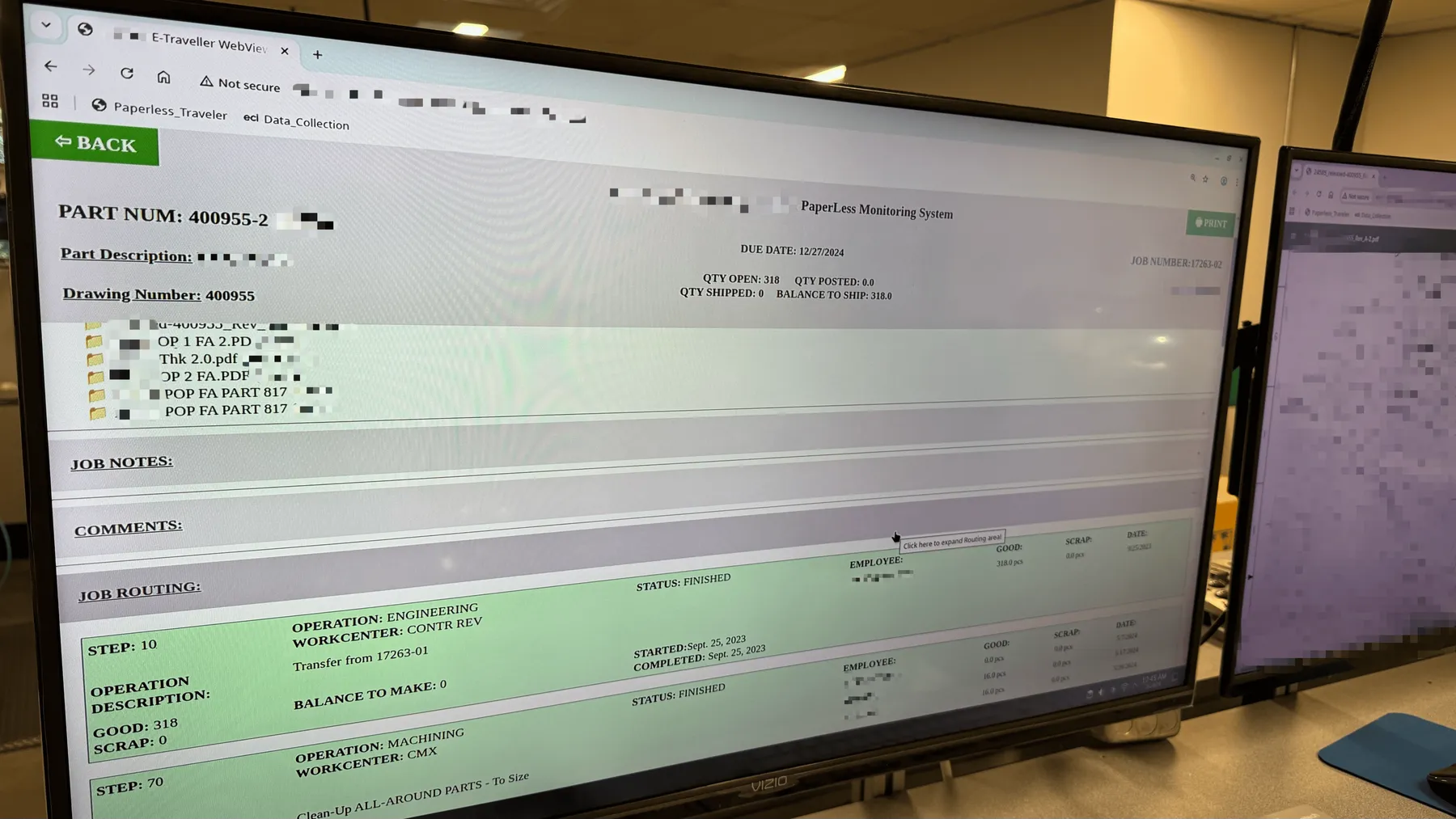
Every machine got a workstation with a screen. The operator marks progress with a single button: the start and end of an operation, how many parts came out good, how many got scrapped. Any update on any part reaches the local server immediately and appears on the management dashboard. A set of checks is built in: a new operation cannot begin until the previous one is closed, no step can be passed over silently, and so on.
The same screen pulls up everything tied to the order by part number or job number: drawings, updates, comments. Drawings update in real time and push to every machine involved right away. At each operation a worker can leave a comment the others can see.
The production manager and the owner each got their own dashboard — each one shows what that person needs to make decisions in real time.
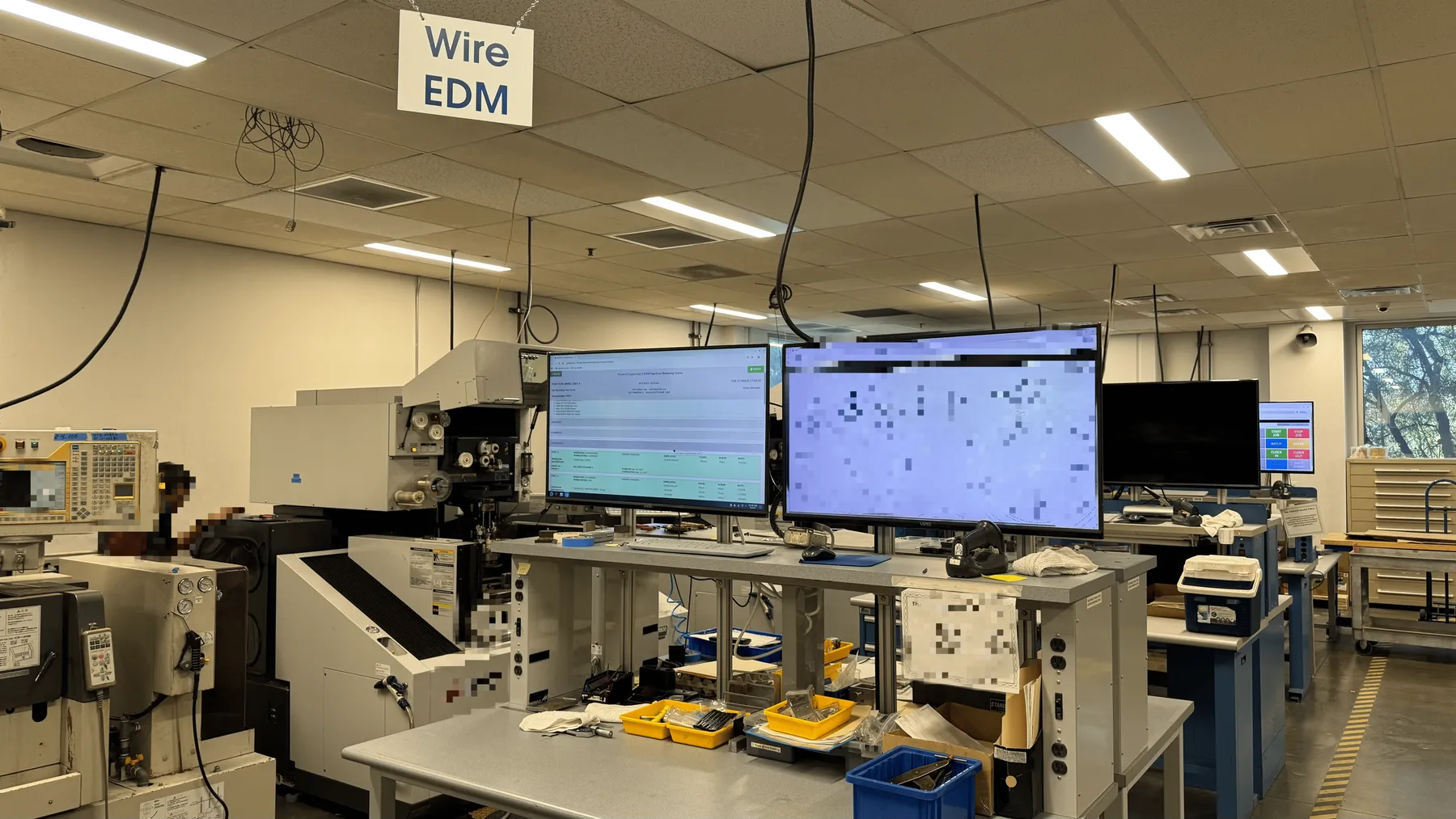
Design and development took three months; in parallel, we installed and set up the workstations at the machines — a Linux thin client, two monitors each. Within a month after that, the company had moved fully to digital tracking of orders and machine load.
The result
The full state of the floor — which jobs are running, where the delay is, how much scrap there is — now reads out reliably and in real time, with nobody collecting it by hand. Every operation is logged on the spot, the moment it happens. Time spent checking the status of orders and operations fell by 90%. Bottlenecks that nobody could see before can now be measured, and work and shipments planned around them.
Preparation for QA/QC checks and ISO audits got much faster too: what used to take one to two weeks of compiling the data by hand is now ready in a few hours, historical data included.
The system went live on every workstation. The first and hardest stretch of adoption ran about a month — the staff quickly saw what it did for them: data doesn't get lost, a record can be corrected rather than crossed out, and the current drawing is on the screen instead of on paper.
The system has been running at the company for more than four years. By agreement, all source code went to the client, and the company's own IT department has since extended it several times on its own as new needs came up. LAB412 provides support where needed.